Tests · Colonoscopy

The test with a three-day wait.
Not a three-month one.

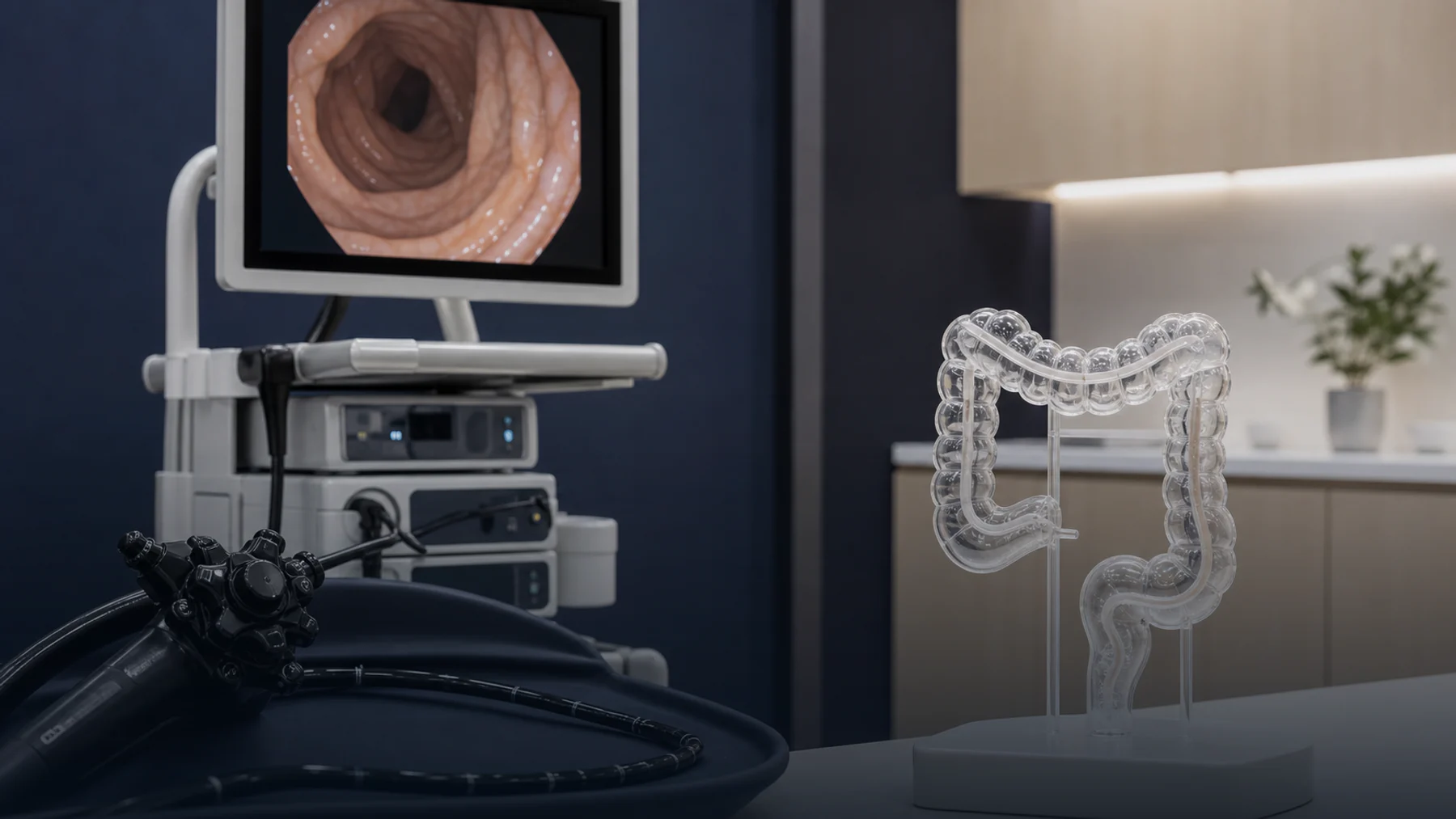
A colonoscopy examines the full length of the large intestine with a flexible camera, and is the standard screening test for colorectal cancer and polyps. It is performed under sedation at Korean partner centers, typically alongside a gastroscopy in the same visit.
20–40 min
Procedure time

Under sedation, plus recovery time.

0 mSv
Radiation dose

An optical procedure: no imaging radiation.

66.4%
Colonoscopy uptake in Korea, 2024

Share of the eligible population who had a colonoscopy, up from 56.5% in 2023. That jump drove national colorectal screening to a record 74.4%. This is an uptake rate, not a share of people who picked one test over another; the separate preference figure was 66.2%.

₩1,000,000
Cheapest program including it

KMI Global's Signature program, which offers a colonoscopy as one of two choices on top of its Standard contents.

₩1.1M
With a sedation option published

Hanaro's Silver program, men's price, which lists a colonoscopy with conscious sedation. KMI Global's Signature program at ₩1,000,000 offers a colonoscopy as one of two choices in its second option group.

From 1 wk
Earliest slot

One week is the earliest an imaging slot can be held, and there is no referral step before it.

~1 wk
Full written report

English report in your hands in about a week. You also get a consultation on preliminary findings on the day of the screening, before you leave.

Programme contents and prices from each partner centre's own foreigner-facing published list, read 2026-08-05: KMI Global and Hanaro Medical Foundation's English site. Standalone per-test prices are a Korean partner centre's 비급여 (non-covered) posting, the itemised list 의료법 제45조 requires a clinic to publish, read the same day. Scheduling and report turnaround are Meridiko's own operating figures, confirmed 2026-08-06, not a centre's published ones (https://global.kmi.or.kr/examination/foreigner_examination; https://en-mobile.hanaromf.com/program/prog01/prog01_01.jsp), measured 2026-08-05. Dollar figures are converted from each centre's won price at ₩1,342 = $1 (open.er-api.com, 2026-09-13). The won figure is the price; the pairing moves with the rate.

What it finds, and what it does not

What it finds, and what it does not.

Polyps, which can typically be removed during the same procedure, plus inflammation, diverticulosis and early structural changes in the colon and rectum.

A colonoscopy does not examine the stomach or oesophagus (that is a gastroscopy), and an incomplete bowel preparation can hide small lesions, which is why the prep instructions matter as much as the procedure itself.

Suitability

Who it suits, and who should not have it.

Suits: Adults at or past the recommended colorectal-screening age, and anyone with a family history of colorectal cancer or polyps. Korea reached a record 74.4% national colorectal screening rate in 2024, and the reason was colonoscopy specifically: uptake went from 56.5% to 66.4% in a single year. Worth knowing what that rise is and is not. Korea's national programme has offered adults 50 and over an annual faecal occult blood test since 2004, with colonoscopy as the follow-up on a positive result, so the jump is in how many people end up having a colonoscopy rather than a switch of primary test. That matters practically rather than patriotically. A test the local system performs at that volume is one the endoscopy suite is set up for, staffed for, and reading all day.

Should not have it: People with unstable cardiorespiratory conditions not yet assessed, or a suspected bowel perforation. Flag either to your coordinator before booking sedation.

In context

How it differs from the related test.

A whole-body MRI does not reliably detect early colonic lesions; a colonoscopy is the specific, sensitive test for the colon, and the one a whole-body protocol does not replace.

Which tier includes it

Included from Comprehensive.

Included from the Comprehensive tier up (and so also in Advanced). The Essential tier does not include it. See /pricing/ for what else moves between tiers.

SEE THE FULL TIER LADDER
Related tests

Often booked together.

Gastroscopy

The upper endoscope. Under sedation, same day as your colonoscopy.

Tumor marker panel

A blood draw. Read alongside your imaging, not instead of it.

FAQ

Questions worth asking before you book.

Is the bowel preparation the same as at home?
The prep protocol is broadly similar to Western practice: a clear-liquid diet and a prescribed prep solution the day before. Your coordinator sends exact instructions and timing once your appointment is confirmed.
Will I be awake during the procedure?
No. Sedation is standard at partner centers, and most patients have no memory of the procedure itself.
What happens if a polyp is found?
Most polyps can be removed during the same procedure and sent for pathology; the report states what was found and any recommended follow-up interval.
Is a colonoscopy better than the stool or blood tests I am offered at home?
They answer different questions, and this page will not pretend otherwise. A stool or blood test is a detection test: it tells you whether to look, and it is easier to repeat. A colonoscopy looks, and it can remove a polyp in the same session, which is the part no detection test does. The honest trade is invasiveness and preparation against conclusiveness. If you are already travelling for a checkup, the practical argument for the colonoscopy is that the visit is the hard part and you are making it anyway.
Are colorectal cancer outcomes actually better in Korea?
Korean 5-year relative survival for colorectal cancer, all stages, is 75.6% for cancers diagnosed 2019–2023. The comparable SEER figure for the United States is 65.4%, for cancers diagnosed 2016–2022. Two caveats belong with that gap rather than after it: the two cohorts cover different years, so this is not a like-for-like comparison, and part of any screening-driven survival difference is a measurement effect, because finding a cancer earlier lengthens measured survival even where it does not change the outcome. What the figures do show is a real difference in when the disease is caught.