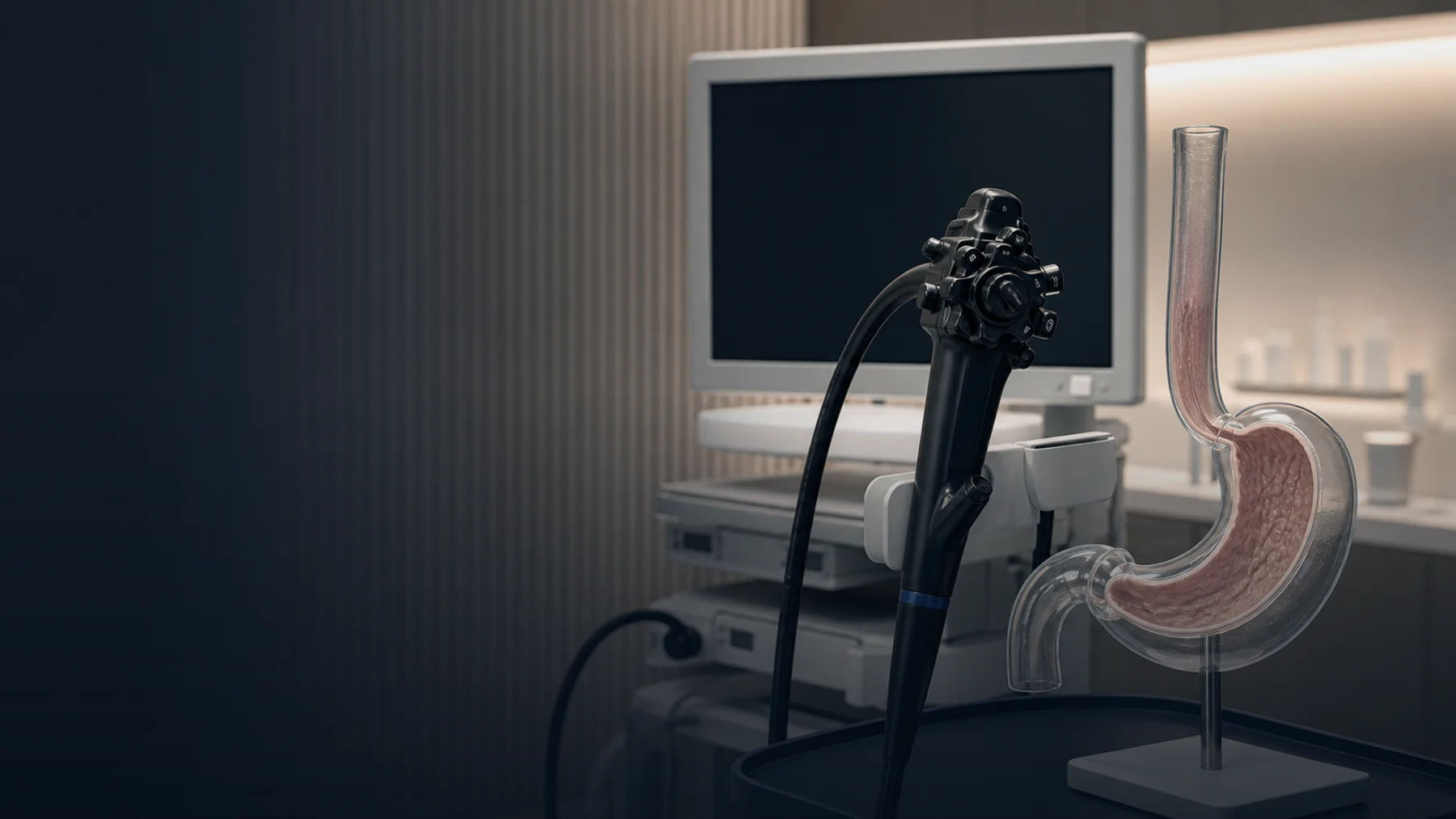
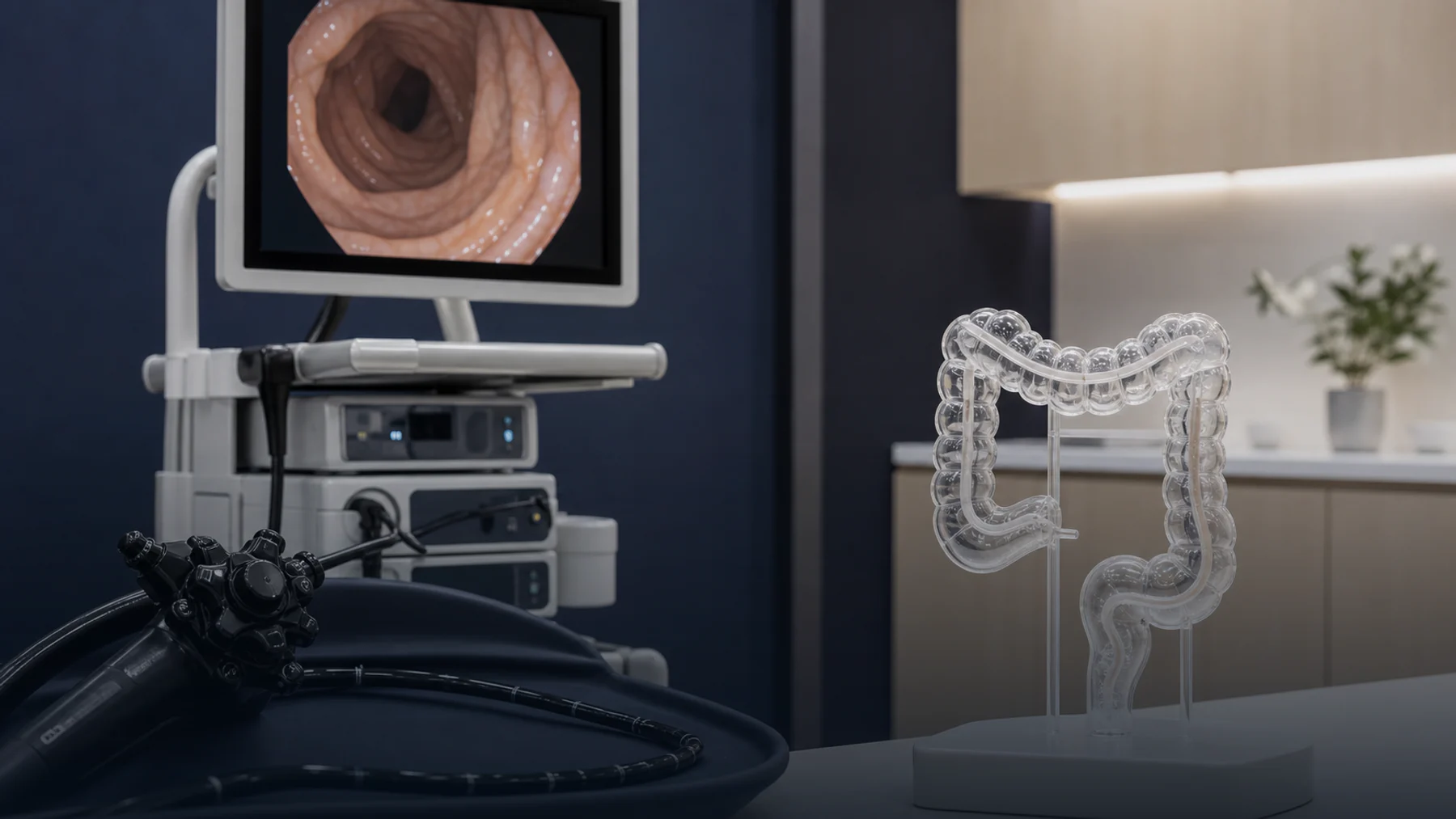
The upper endoscope. Under sedation, same day as your colonoscopy.
A gastroscopy passes a thin camera down the throat to examine the oesophagus, stomach and the first part of the small intestine. At Korean partner centers it is routinely performed under sedation, and commonly scheduled back-to-back with a colonoscopy in the same visit.
Share of gastric cancers diagnosed at localized stage, both sexes, 2019–2023. The comparable SEER figure for the United States is 32%. A population statistic about where the disease is caught, not a prediction about any one person.
₩450,000
Cheapest program including it
Hanaro's Basic program, men's price, which lists a gastroscopy. Women's is ₩480,000 and the published exam time is 2 hours.
+₩50,000
Sedation, where priced separately
A partner centre publishes sedation for its endoscopy as a ₩50,000 add-on. KMI Global's Standard program at ₩500,000 offers a gastroscopy as one of three choices in its first option group.
From 1 wk
Earliest slot
One week is the earliest an imaging slot can be held, and there is no referral step before it.
~1 wk
Full written report
English report in your hands in about a week. You also get a consultation on preliminary findings on the day of the screening, before you leave.
Programme contents and prices from each partner centre's own foreigner-facing published list, read 2026-08-05: KMI Global and Hanaro Medical Foundation's English site. Standalone per-test prices are a Korean partner centre's 비급여 (non-covered) posting, the itemised list 의료법 제45조 requires a clinic to publish, read the same day. Scheduling and report turnaround are Meridiko's own operating figures, confirmed 2026-08-06, not a centre's published ones (https://global.kmi.or.kr/examination/foreigner_examination; https://en-mobile.hanaromf.com/program/prog01/prog01_01.jsp), measured 2026-08-05. Dollar figures are converted from each centre's won price at ₩1,342 = $1 (open.er-api.com, 2026-09-13). The won figure is the price; the pairing moves with the rate.
What it finds, and what it does not
What it finds, and what it does not.
Inflammation, ulcers, polyps, hiatal hernia and early structural changes in the oesophagus, stomach and duodenum; biopsies can be taken during the same procedure.
A gastroscopy does not examine the small or large intestine beyond the duodenum. A colonoscopy covers the lower tract, and the two are complementary, not substitutes for each other.
Suitability
Who it suits, and who should not have it.
Suits: Adults screening for stomach and oesophageal disease, especially where Helicobacter pylori or reflux symptoms are a family or personal history. It is worth knowing why this test is ordinary in Korea and rare in US screening: Korea has run a national gastric screening programme since 1999, covering every adult aged 40 to 74 every two years, and in 2024 gastric screening had the highest participation of the six cancers it covers, at 77.4%. For most of that history the programme offered either an upper-GI series or a gastroscopy; the 2025 revision of the national recommendation, its first since 2015, elevated gastroscopy to effectively the sole primary method and left the upper-GI series for cases where an endoscopy is not possible. A test performed at that volume is a test the staff around you do all day.
Should not have it: People with significant bleeding disorders not yet assessed, or unstable cardiorespiratory conditions. Flag any of these to your coordinator before booking sedation.
In context
How it differs from the related test.
A colonoscopy examines the lower digestive tract; a gastroscopy examines the upper tract. Partner centers commonly perform both under one sedation session, covering the full length of the gut in a single visit.
Which tier includes it
Included from Essential.
Included from the Essential tier up (as a gastroscopy or an upper-GI series). Every Meridiko program includes one or the other. See /pricing/ for the full tier ladder.
Under sedation, most patients report no memory of the procedure and minimal discomfort afterward. A sore throat for a day is the most common after-effect.
Can I have a gastroscopy and colonoscopy on the same day?
Yes. This is the standard pairing at partner centers, done under one sedation session to avoid two separate recovery periods.
How do I prepare?
Fasting for several hours beforehand; your coordinator sends exact timing once your appointment is confirmed.
Does finding stomach cancer earlier actually change the outcome?
The population figures say stage at diagnosis matters more than anything else about the disease. Among cancers diagnosed in Korea between 2019 and 2023, gastric cancer found at localized stage had a 5-year relative survival of 97.6%; found at distant stage it was 7.5%. Two things have to be said alongside that. It describes populations and not any individual, and a screening programme flatters its own survival figures by construction, because finding a disease earlier lengthens measured survival even when it does not change the date of death. What the figures support is that the stage a cancer is found at is not incidental, and that a country screening at Korea's volume finds 65.3% of gastric cancers still localized against 32% in the United States.
Why is a gastroscopy part of a routine checkup here but not at home?
Because the underlying disease burden differs and the screening programmes were built around it. Korea has offered biennial gastric screening since 1999, to adults aged 40 to 74, so the equipment, the sedation practice and the reading volume all exist as ordinary infrastructure. In 2025 the national recommendation went further and made gastroscopy effectively the only primary method, on domestic evidence that it beats the upper-GI series on both accuracy and mortality reduction. No equivalent population screening programme for gastric cancer exists in the United States, which is why the test tends to appear there only after symptoms.