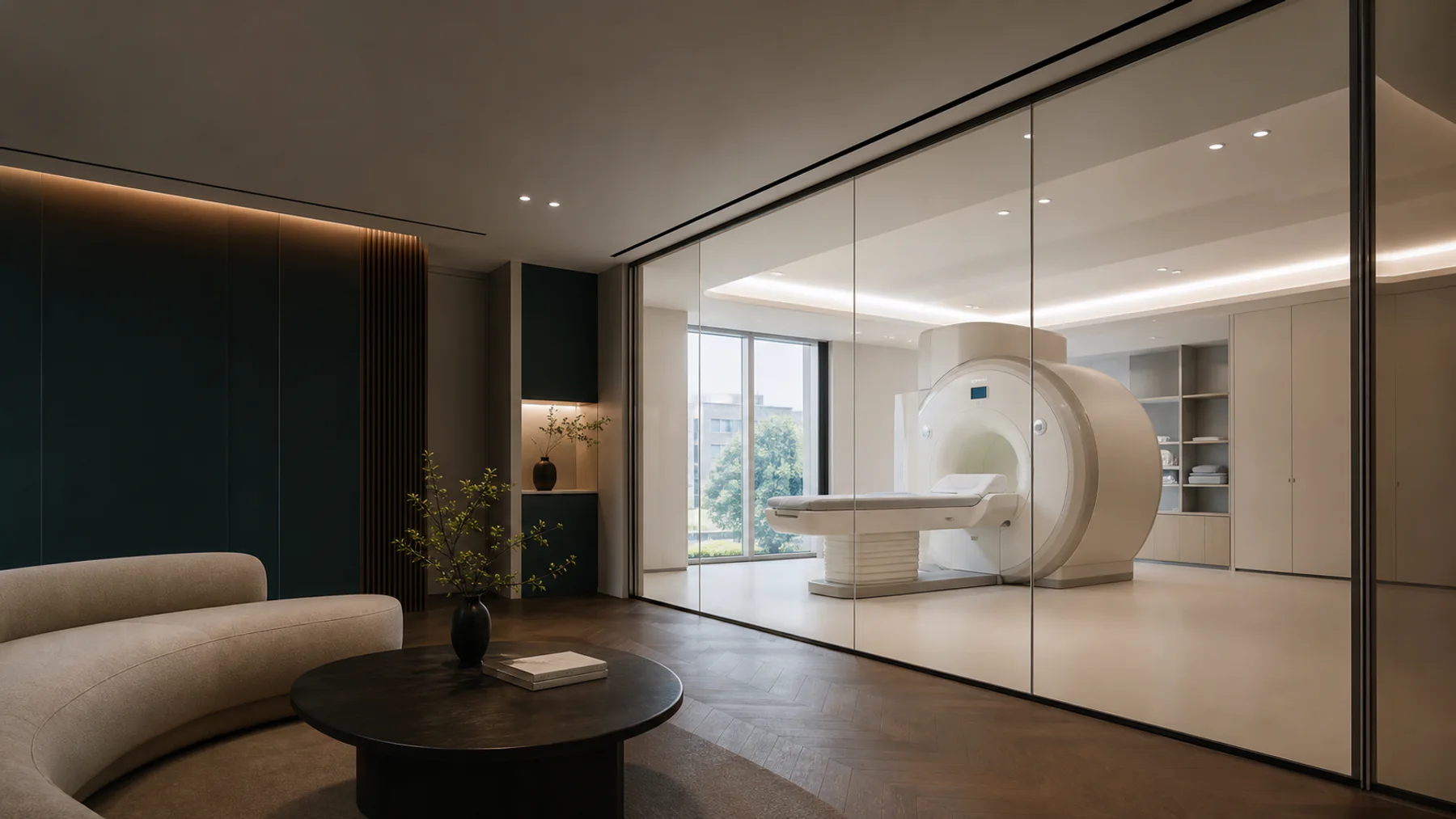
A whole-body MRI is the scan people reach for when they want one test to check everything. It comes closer than most. In a single session of about 45 to 70 minutes, with no radiation at all, it covers the head, neck, chest, abdomen and pelvis, and it is genuinely good at finding tumours, aneurysms and structural disease in people who have no symptoms. But the same design that makes it broad also gives it two specific blind spots, and knowing them is the difference between a scan that reassures you correctly and one that reassures you about the wrong thing.
What it is good at
The appeal is genuine, and easy to understand. One scan, head to torso, no ionising radiation, which is why it is attractive as a wide screen in a way a whole-body CT could never be. Sweeping the whole torso by CT would stack up a meaningful cumulative dose. The MRI carries none, and for structural disease across the solid organs, for a tumour that has not announced itself, for an aneurysm sitting quietly, it is a strong survey. For someone without symptoms who wants a broad structural baseline, that is a coherent reason to book it.
The two things it misses
The blind spots are easy to name, because they come down to two tests the scan cannot stand in for.
The first is small lung nodules. A whole-body MRI does not reliably detect nodules under about 5mm, and that size is exactly where lung screening earns its keep. The purpose-built test there is a low-dose chest CT, which is faster, uses a small radiation dose, and is far more sensitive to precisely the small nodules the MRI would miss. If the lungs are a real concern, a clean whole-body MRI does not answer the question.
The second is the colon. A whole-body MRI is not the test for early colonic lesions. The lining of the bowel is a job for a colonoscopy, which looks at the surface directly and can remove a lesion in the same sitting. An MRI passing over the abdomen is not doing that work, and reading a normal whole-body scan as clearance on the colon is the same kind of mistake as reading a normal echocardiogram as clearance on the coronary arteries.
| Question | Right test | Why not the whole-body MRI |
|---|---|---|
| Tumours, aneurysms, structural disease | Whole-body MRI (≈₩319,000 per region) | This is what it is built for. |
| Small lung nodules | Low-dose chest CT | The MRI misses nodules under about 5mm. |
| Early colon lesions | Colonoscopy | The MRI does not read the bowel lining. |
The prices, and how it is sold
Because a Korean partner centre publishes its non-covered (비급여) prices, the figures here are the centre’s own, read on 2026-08-19. A partner centre prices imaging per region at about ₩319,000, and the widest published programme that bundles a broad MRI survey runs to roughly ₩3,000,000. The full detail of scan time, coverage and the two gaps sits on the whole-body MRI test page.
How to think about it
Book a whole-body MRI for what it is, a no-radiation structural survey from head to torso for someone without symptoms, and it does that job well. The one thing to be careful of is letting a clean result stand in for the two tests it cannot replace. If the lungs are the worry, add the low-dose chest CT. If the colon is, the colonoscopy is the test. And if a specific organ is the reason for the trip, a dedicated study of that organ, whether a brain MRI and MRA or an abdominal CT, reads it more sharply than a survey passing through. The written report usually reaches you two weeks later (one week at the soonest, three at most), with a consultation on preliminary findings before you leave.