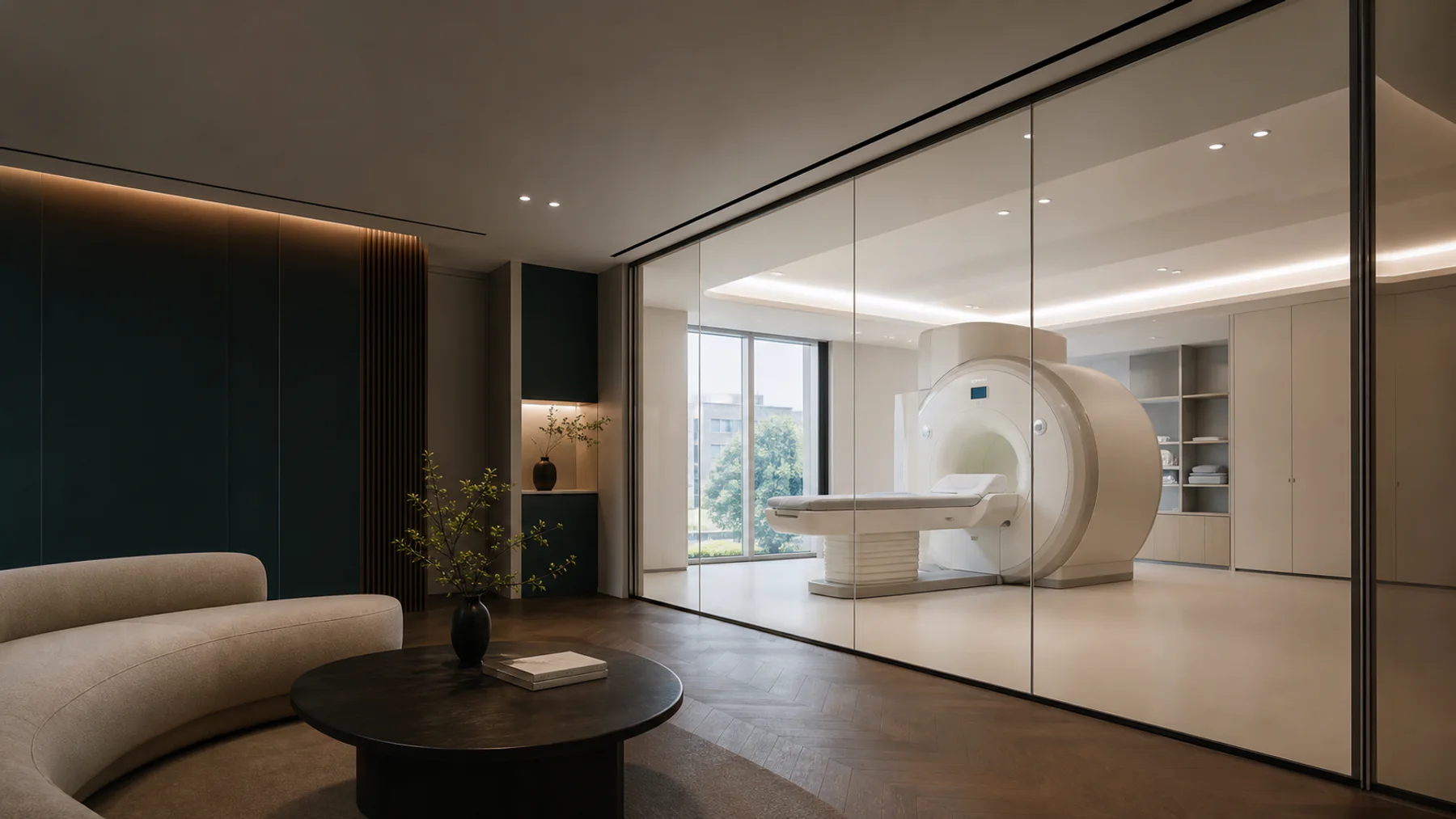
A low-dose chest CT is one of the few screening scans with a clear, evidence-backed audience, and it is narrower than most people expect. It is a rapid CT of the lungs, tuned to find small nodules at a fraction of a standard CT’s radiation dose. That narrowness is really the point of it. It does one job well, and the two things that most often go wrong around it are giving it to the wrong person and reading its clean result as covering more than the lungs.
What it does, and the dose that makes it usable
The scan takes about 10 to 15 minutes and delivers roughly 1 to 1.5 mSv. That low dose is what turns a chest CT from an occasional test into a repeatable screen. It finds lung nodules, including small ones that a whole-body MRI would miss, along with other structural findings in the chest. Sensitivity to small nodules is exactly where it earns its place, because a small nodule caught and followed is the entire mechanism by which lung screening changes outcomes.
Who it is for
The strongest case is lung cancer screening in current and former heavy smokers. That is the group where the evidence for scanning is clearest, and for them a low-dose chest CT is not an optional extra but the recommended test. Beyond that group it becomes a common and reasonable add-on for anyone screening the chest who wants more than an X-ray, but the reasoning shifts from “recommended” to “a choice worth making on a reason.” For a lifelong non-smoker with no particular risk, it is defensible, but it is not a default, and adding it by reflex is how a screening trip fills up with scans that answer questions nobody was really asking.
A nodule is not a diagnosis
This is the part worth carrying into the appointment. Because the scan is sensitive, it finds small nodules often, and most of them are not cancer. The report reflects that. It sets out a follow-up interval, a recommended time to re-scan and look for change, rather than a verdict. A nodule that stays the same size over that interval is the outcome the follow-up is built to confirm. Reading the first scan as a yes-or-no answer, in either direction, asks it for something it was never designed to give.
What it does not cover
The other half of reading it correctly is knowing where it stops. A low-dose chest CT evaluates the lungs. It does not assess the heart, the abdomen or the pelvis. Coronary risk is a separate question, answered by a calcium score or a cardiac CT. The abdomen is its own scan. And a broad structural survey of five regions is what a whole-body MRI is for, though that survey is the one that misses the small lung nodules this test is built to catch. The two are complements, not substitutes.
| Test | Best at | Dose | Price |
|---|---|---|---|
| Low-dose chest CT | Small lung nodules | 1–1.5 mSv | ≈₩130,000 |
| Whole-body MRI | A five-region structural survey | 0 mSv | ≈₩319,000 per region |
Because a Korean partner centre publishes its non-covered (비급여) prices, these figures are the centre’s own, read on 2026-08-05. A partner centre prices the low-dose chest CT at about ₩130,000 standalone, and the cheapest programme that includes it runs to roughly ₩660,000. The full breakdown sits on the low-dose chest CT test page.
The short version
If you are a current or former heavy smoker, this is the lung screen to have, and the follow-up interval on any nodule it finds is a feature, not a scare. If you are not, it is a reasonable add-on to decide on rather than collect. Either way, read the result for what it is: an answer about the lungs, at a dose low enough to repeat, and nothing about the heart or the abdomen that would need their own tests. The written report usually reaches you two weeks later (one week at the soonest, three at most), with a consultation on preliminary findings before you leave.