Tests · Coronary calcium score

A five-minute scan.
A number your cardiologist already knows how to use.

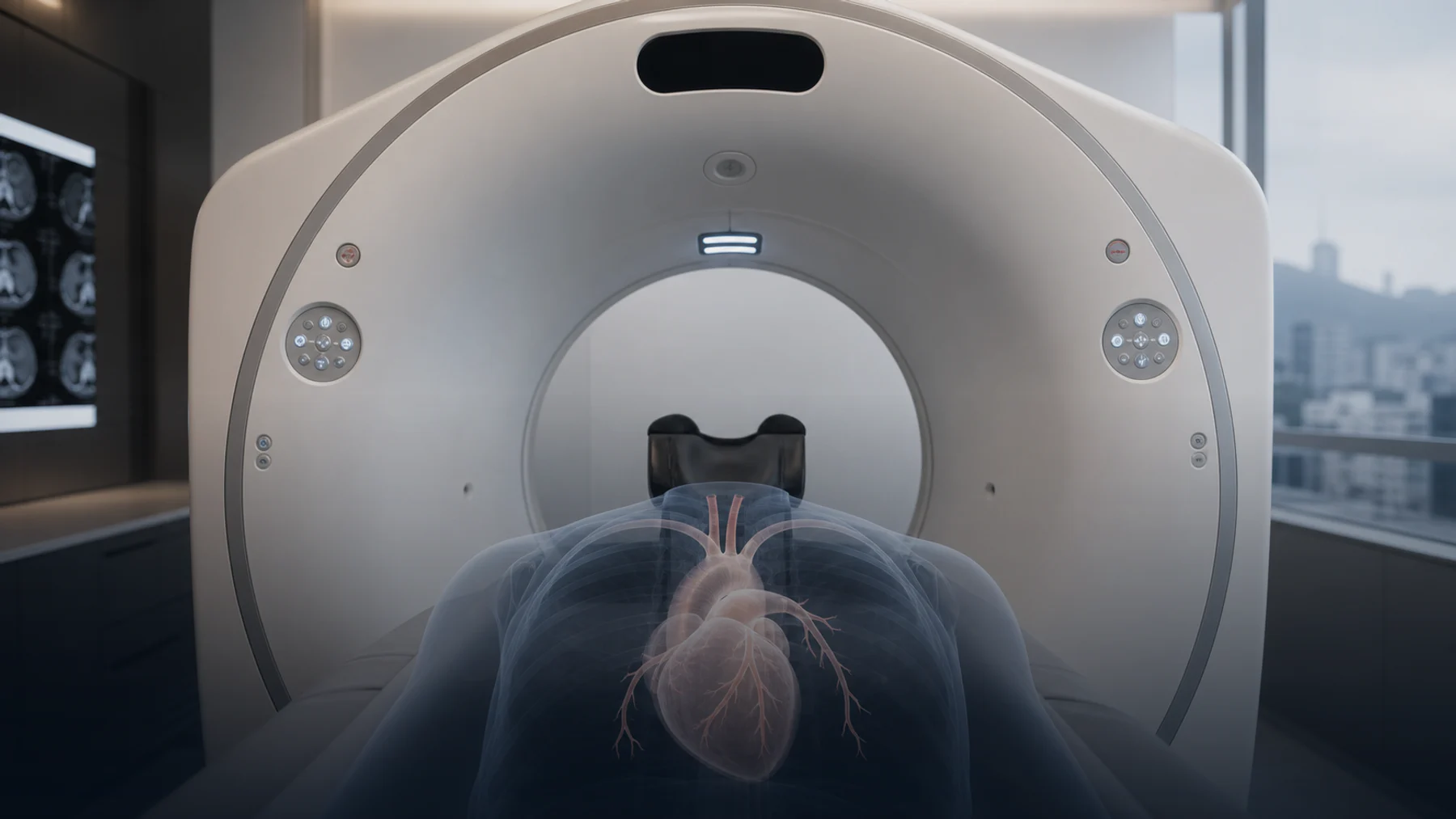
A coronary calcium score is a rapid, low-dose CT scan that measures calcified plaque in the heart's arteries and returns a single score used to estimate cardiovascular risk. It takes about five minutes and requires no contrast injection.


5 min
Scan time

No contrast injection required.

≈1 mSv
Radiation dose

A low-dose, targeted acquisition.

₩280,000
Closest standalone price

MediOne's published price for a 3D cardiac-vessel CT with contrast, which is coronary CT angiography rather than a calcium score. Its own add-on coronary artery screening is ₩500,000.

₩500,000
Cheapest program including a calcium score

MediOne's Basic program lists coronary calcium scoring CT for men. Hanaro's Gold program lists it for both sexes at ₩2,000,000.

From 1 wk
Earliest slot

One week is the earliest an imaging slot can be held, and there is no referral step before it. Meridiko's own operating figure.

~1 wk
Full written report

English report in your hands, which is Meridiko's own delivery target rather than a centre's published figure. You get a consultation on preliminary findings on the day of the screening, before you leave.

Programme contents and prices from each partner centre's own foreigner-facing published list, read 2026-08-05: KMI Global, Hanaro Medical Foundation's English site and MediOne's English site. Standalone per-test prices are MediOne's 비급여 (non-covered) posting, the itemised list 의료법 제45조 requires a clinic to publish, read the same day. Report turnaround is Meridiko's own delivery target rather than a centre's published figure, and is labelled as ours where it appears (https://global.kmi.or.kr/examination/foreigner_examination; https://en-mobile.hanaromf.com/program/prog01/prog01_01.jsp; https://en.medionemedicalcenter.com/m1; https://medionemedicalcenter.com/115), measured 2026-08-05.

What it finds, and what it does not

What it finds, and what it does not.

Calcified plaque in the coronary arteries, reported as a single score used alongside other risk factors to estimate cardiovascular risk.

A calcium score does not detect non-calcified ("soft") plaque or significant narrowing without calcium, and a score of zero does not rule out coronary artery disease. It lowers estimated risk, it does not eliminate it.

Suitability

Who it suits, and who should not have it.

Suits: Adults with intermediate cardiovascular risk who want an objective data point alongside cholesterol and blood pressure: the population most published guidelines target this test at.

Should not have it: People already diagnosed with coronary artery disease, for whom the score adds little. A different, more detailed cardiac work-up is usually more appropriate. Discuss with your coordinator.

In context

How it differs from the related test.

A calcium score is a screening-risk number, not a diagnostic map of blockages the way a CT coronary angiogram is. The angiogram uses contrast and a higher dose to show the arteries directly.

Which tier includes it

Not itemised on any tier.

None of the tiers on this site itemise a coronary calcium score by name. The closest included tests are the Comprehensive tier's CT scan and cardiac ultrasound, or KMI's dedicated Cardiovascular precision program (see /pricing/). Confirm with your coordinator whether a calcium-score protocol specifically is available before booking on the strength of this page alone.

SEE THE FULL TIER LADDER
Related tests

Often booked together.

Low-dose chest CT

The lung-cancer screening test. Ten minutes, minimal dose.

Full blood panel

The baseline every program includes. Because the scans need context.

FAQ

Questions worth asking before you book.

Does a calcium score need contrast dye?
No. This is a non-contrast scan, which is part of why it is fast and low-dose.
What does a score of zero mean?
It means no calcified plaque was detected, which is associated with lower risk. It does not fully rule out coronary artery disease, particularly non-calcified plaque.
Who is this test for?
It is most useful for adults at intermediate cardiovascular risk, as one input alongside cholesterol, blood pressure and family history. Your own physician is best placed to interpret the score against those.