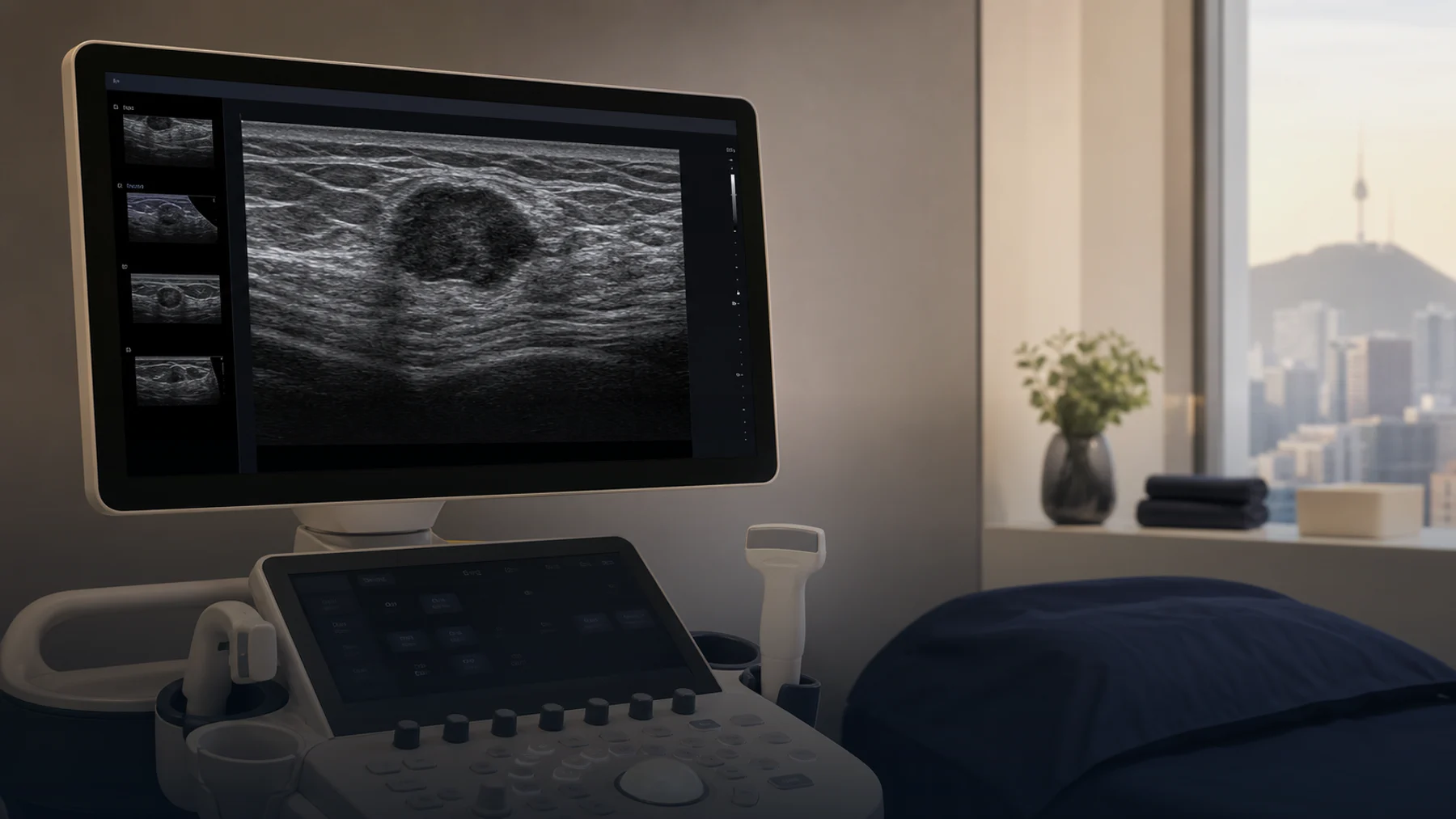
A breast ultrasound finds what a mammogram misses in dense breast tissue, which is why Korean screening programs pair the two rather than choosing between them. No radiation, no compression, about fifteen minutes.
Sound waves only. Mammography, which it complements, does use X-rays.
₩150,000
Standalone price
A partner centre's published non-covered price for a breast scan with AI double reading. (≈$112)
₩700,000
Cheapest program including it
Medione B-6. Precision - Women's Health Checkup, the cheapest programme that includes the scan outright rather than as one of a choice. (≈$522)
From 1 wk
Earliest slot
One week is the earliest an imaging slot can be held, and there is no referral step before it.
~1 wk
Full written report
English report in your hands in about a week. You also get a consultation on preliminary findings on the day of the screening, before you leave.
Programme contents and prices from each partner centre's own foreigner-facing published list, read 2026-08-05: KMI Global and Hanaro Medical Foundation's English site. Standalone per-test prices are a Korean partner centre's 비급여 (non-covered) posting, the itemised list 의료법 제45조 requires a clinic to publish, read the same day. Scheduling and report turnaround are Meridiko's own operating figures, confirmed 2026-08-06, not a centre's published ones (https://global.kmi.or.kr/examination/foreigner_examination; https://en-mobile.hanaromf.com/program/prog01/prog01_01.jsp), measured 2026-08-05. Dollar figures are converted from each centre's won price at ₩1,342 = $1 (open.er-api.com, 2026-09-13). The won figure is the price; the pairing moves with the rate.
What it finds, and what it does not
What it finds, and what it does not.
Solid masses, cysts and architectural distortion, and it performs better than mammography in dense tissue, which is the majority of tissue in younger women and in many Asian women at any age.
It is not a replacement for mammography. Mammography sees microcalcifications, an early sign ultrasound is poor at, which is why the two are read together. Neither can tell you whether a mass is cancer; that takes a biopsy.
Suitability
Who it suits, and who should not have it.
Suits: Women with dense breast tissue, women under 40 for whom mammography alone performs poorly, anyone with a palpable lump, and anyone with a family history who wants both tests rather than one.
Should not have it: It is not a substitute for mammography in women of screening age, and choosing it alone on the grounds that it involves no radiation is the mistake this page exists to name.
In context
How it differs from the related test.
Mammography and ultrasound answer different halves of the same question. A breast MRI, which a partner centre prices separately, is a third tier again: far more sensitive, more false positives, and reserved for high-risk surveillance rather than general screening.
Which tier includes it
Included from Advanced.
Included in the women's Advanced tier on this site, and from Hanaro's Silver program. A partner centre prices it standalone at ≈₩150,000 with AI double reading, and prices a non-contrast breast MRI at ≈₩450,000 for cases where surveillance rather than screening is the question.
In screening-age women, yes, and the partner programs include both rather than making you choose. Ultrasound is the addition that covers what compression imaging misses in dense tissue, not the replacement for it.
Is it uncomfortable?
No. There is no compression. A probe and gel, about fifteen minutes.