Tests · Brain MRI / MRA

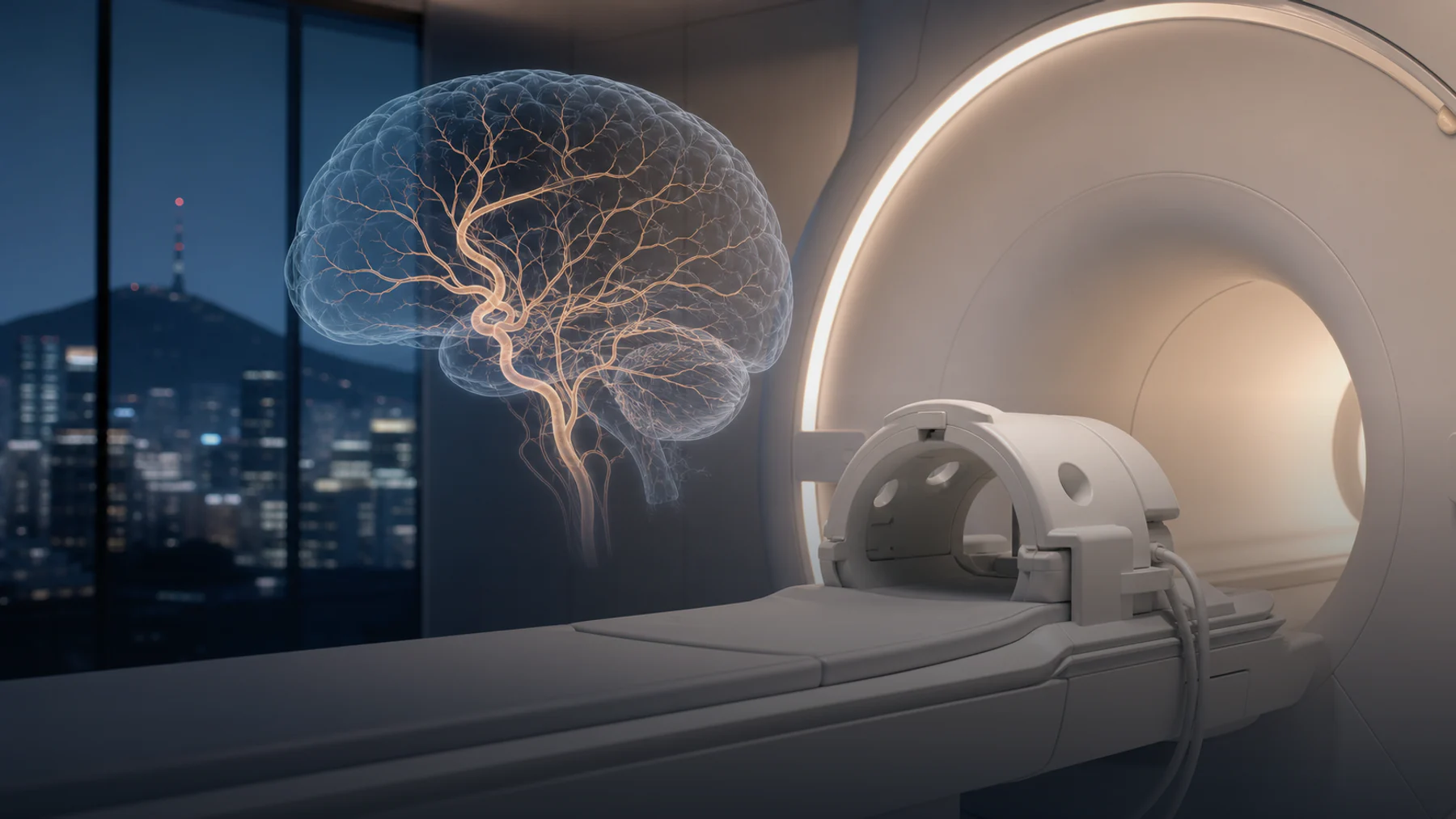
The brain and its blood vessels.
In one appointment.

A brain MRI images the brain's structure, and an MRA (magnetic resonance angiography) images its blood vessels. The two are usually performed together in one appointment. Neither uses ionising radiation.
20–30 min
Scan time

Brain MRI and MRA together.

0 mSv
Radiation dose

No ionising radiation.

₩450,000
Standalone price

MediOne's published non-covered price for a brain MRI, and the same again for the cerebrovascular MRA. Its own Brain program bundles both with an AI brain-age read at ₩1,050,000.

₩2M
Cheapest program including both

Hanaro's Gold program, which lists brain MRI and MRA together. Hanaro publishes the exam time too, at 4 hours.

From 1 wk
Earliest slot

One week is the earliest an imaging slot can be held, and there is no referral step before it. Meridiko's own operating figure.

~1 wk
Full written report

English report in your hands, which is Meridiko's own delivery target rather than a centre's published figure. You get a consultation on preliminary findings on the day of the screening, before you leave.

Programme contents and prices from each partner centre's own foreigner-facing published list, read 2026-08-05: KMI Global, Hanaro Medical Foundation's English site and MediOne's English site. Standalone per-test prices are MediOne's 비급여 (non-covered) posting, the itemised list 의료법 제45조 requires a clinic to publish, read the same day. Report turnaround is Meridiko's own delivery target rather than a centre's published figure, and is labelled as ours where it appears (https://global.kmi.or.kr/examination/foreigner_examination; https://en-mobile.hanaromf.com/program/prog01/prog01_01.jsp; https://en.medionemedicalcenter.com/m1; https://medionemedicalcenter.com/115), measured 2026-08-05.

What it finds, and what it does not

What it finds, and what it does not.

Structural brain changes, small strokes, tumours and aneurysms, and narrowing or abnormalities in the brain's major blood vessels.

A brain MRI/MRA is a structural snapshot, not a functional or cognitive assessment. It does not diagnose conditions like early dementia on its own; that requires clinical assessment alongside any imaging findings.

Suitability

Who it suits, and who should not have it.

Suits: Adults with a family history of aneurysm or stroke, or anyone who wants a structural baseline as part of a broader screening program.

Should not have it: People with certain metal implants, pacemakers not confirmed MRI-safe, or significant claustrophobia. Tell your coordinator before you book.

In context

How it differs from the related test.

A whole-body MRI's brain coverage is a general survey; a dedicated brain MRI/MRA uses a finer protocol specific to brain and vessel detail, which is why the two are offered as separate tests rather than one replacing the other.

Which tier includes it

Included from Advanced.

Meridiko's Advanced tier includes an MRI by region, and brain is one of the three regions offered. This is that scan. Confirm with your coordinator that the MRA (vessel) pass is bundled into your centre's brain-MRI protocol, rather than assuming it.

SEE THE FULL TIER LADDER
Related tests

Often booked together.

Whole-body MRI

One scan. Five regions, no radiation.

Coronary calcium score

A five-minute scan. A number your cardiologist already knows how to use.

FAQ

Questions worth asking before you book.

Do I need a brain MRI and MRA separately?
They are usually performed together in one appointment using the same scanner session, covering both brain structure and its blood vessels.
Will this detect a stroke risk?
It can find aneurysms, significant vessel narrowing and evidence of prior small strokes. It is one input into stroke-risk assessment, not a complete risk calculation on its own.
Is contrast dye used?
Some MRA protocols use a gadolinium-based contrast agent; your coordinator checks kidney function beforehand, since contrast is not used when kidney function is significantly reduced.