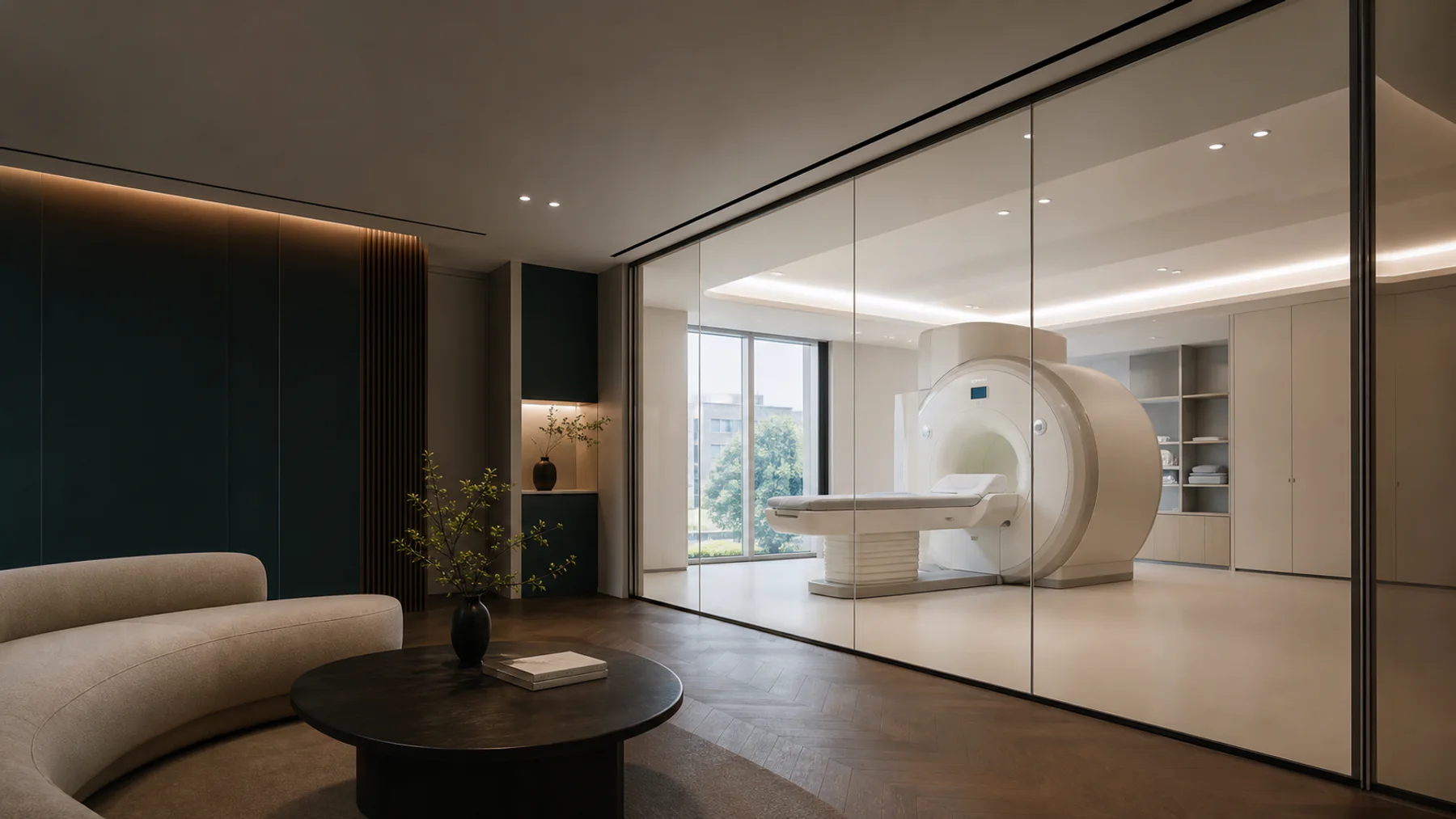
A spine MRI is the test that explains most persistent neck or lower-back pain, and it is also the test most likely to find something that is not the reason you are in pain. Both of those are true at once, and holding them together is the difference between a scan that helps and one that just worries you. If you have searched for “spine MRI”, this is the part worth understanding before you book.
The scan images the discs, the spinal cord and the nerve roots, the soft tissue that an X-ray cannot show and a CT shows only in outline. It uses no radiation. One region takes about twenty to thirty minutes, and the partner centres price it per region rather than per spine, which turns out to matter for both the cost and the booking.
What it shows
A spine MRI is the standard test when pain radiates. Pain that travels down an arm or a leg, numbness that will not settle, weakness that is new: these are the patterns that point at a nerve, and the MRI is what shows the nerve being pressed. It finds disc herniation and degeneration, spinal stenosis where the canal has narrowed, compression of a nerve root, signal change in the cord itself, and most tumours or infections of the spine. When an earlier X-ray or CT came back inconclusive and the pain has not moved, the MRI is usually the next step rather than a repeat of the same picture.
What a finding does not tell you
This is the part the search results rarely lead with, and it is worth sitting with, because a spine MRI does not tell you that what it found is the cause of your pain. Disc bulges are so common in people with no symptoms that a scan of a pain-free back will often turn up several. Read in isolation, that list of findings can look like a diagnosis, when it is really nothing of the kind.
What makes a finding matter is agreement with the clinical picture: the pattern of the pain, where it radiates, what an examination shows. A spine MRI is meant to be read alongside that, not instead of it. This is also why a spine scan is rarely the right first move for pain that is new and already improving. Imaging something that is settling on its own tends to buy a finding that then needs explaining, when waiting a few weeks would have answered the question for free.
The prices, read from a published list
Because a Korean partner centre publishes its non-covered (비급여) prices, these are the centre’s own figures, read on 2026-08-05.
| Study | Standalone price | What it is for |
|---|---|---|
| Spine MRI, one region | $238 (≈₩319,000) | Discs, cord and nerves in the cervical, thoracic or lumbar spine. |
| Whole spine, sagittal | ≈₩650,000 | The full spine in one study, cheaper than two separate regions. |
| Spinal CT | ≈₩91,000 | Bone in more detail, at a fraction of the price. Not soft tissue. |
| Programme with two regions | $2,385 (≈₩3,200,000) | Hanaro's Platinum, men's price, lists cervical and lumbar MRI together. |
The per-region pricing is the thing to plan around. A programme’s top tier includes a single MRI region and lets you choose brain, cervical or lumbar. If you want more than one region of spine, a partner centre’s per-region price at about ₩319,000 or the whole-spine sagittal study at about ₩650,000 is usually cheaper than moving up a tier to get the second region bundled. Name the region, or name the whole spine, in the request. The full breakdown of scan time and what it does and does not find sits on the spine MRI test page.
MRI or CT for the spine
The two are not interchangeable. A spine CT shows bone in more detail and costs a fraction as much, about ₩91,000 against roughly $238 for the MRI of one region. But bone is not usually the question in radiating pain. The MRI is what shows the discs, the cord and the nerves, the soft tissue where the cause of a trapped nerve actually lives. For a fracture the CT may be the better first look; for pain shooting into a limb, the MRI is the one that answers it.
The short version
Book the spine MRI when the pain radiates, when numbness or weakness will not settle, or when an earlier scan left the question open. Choose the region, or the whole spine, before the day rather than on it. And read the report as one half of a conversation, the imaging half, that only means something next to an examination. The other MRI people often pair it with is the brain MRI and MRA, priced and scheduled the same way, and a whole-body MRI surveys the spine in passing without replacing a dedicated study of it. Whichever you choose, the written report usually reaches you two weeks later (one week at the soonest, three at most), with a consultation on preliminary findings before you leave.