A Seoul hospital checkup and the American scan startups, Prenuvo, Ezra and Neko Health, are chasing the same customer: someone who wants a broad screen, will pay for it themselves, and is tired of waiting for a doctor to decide they are allowed one. They are not, however, the same product. This is an honest comparison of what each one actually images, what it costs, and the single real advantage each side holds.
What the US startups actually are
They fall into three shapes, and the shape matters more than the branding.
Neko Health is a body scan, not a scanner in the radiology sense. It uses its own surface sensors, a blood panel and AI analysis, with no MRI and no radiation. That makes it broad and comparatively cheap, $499 at its New York clinic, and genuinely useful for skin, cardiovascular and metabolic markers. What it does not produce is cross-sectional imaging of the organs inside you. It is a wide first look, not a deep one.
Prenuvo and Ezra are whole-body MRI. One imaging method, no radiation, a strong structural survey of the head, torso and pelvis, Prenuvo runs from $1,199 for a focused scan to $2,499 for the whole body, and Ezra from about $999 to $3,999. Ezra has since been acquired by the blood-testing company Function Health. What a whole-body MRI leaves out is worth knowing before you treat it as a full screen, and a separate article sets out its two blind spots in detail.
A third group, low-dose CT services such as Craft Body Scan, screen the heart, lungs and abdomen by CT for a few hundred to a couple of thousand dollars. Narrower again, and radiation-based rather than radiation-free.
What a Korean checkup is
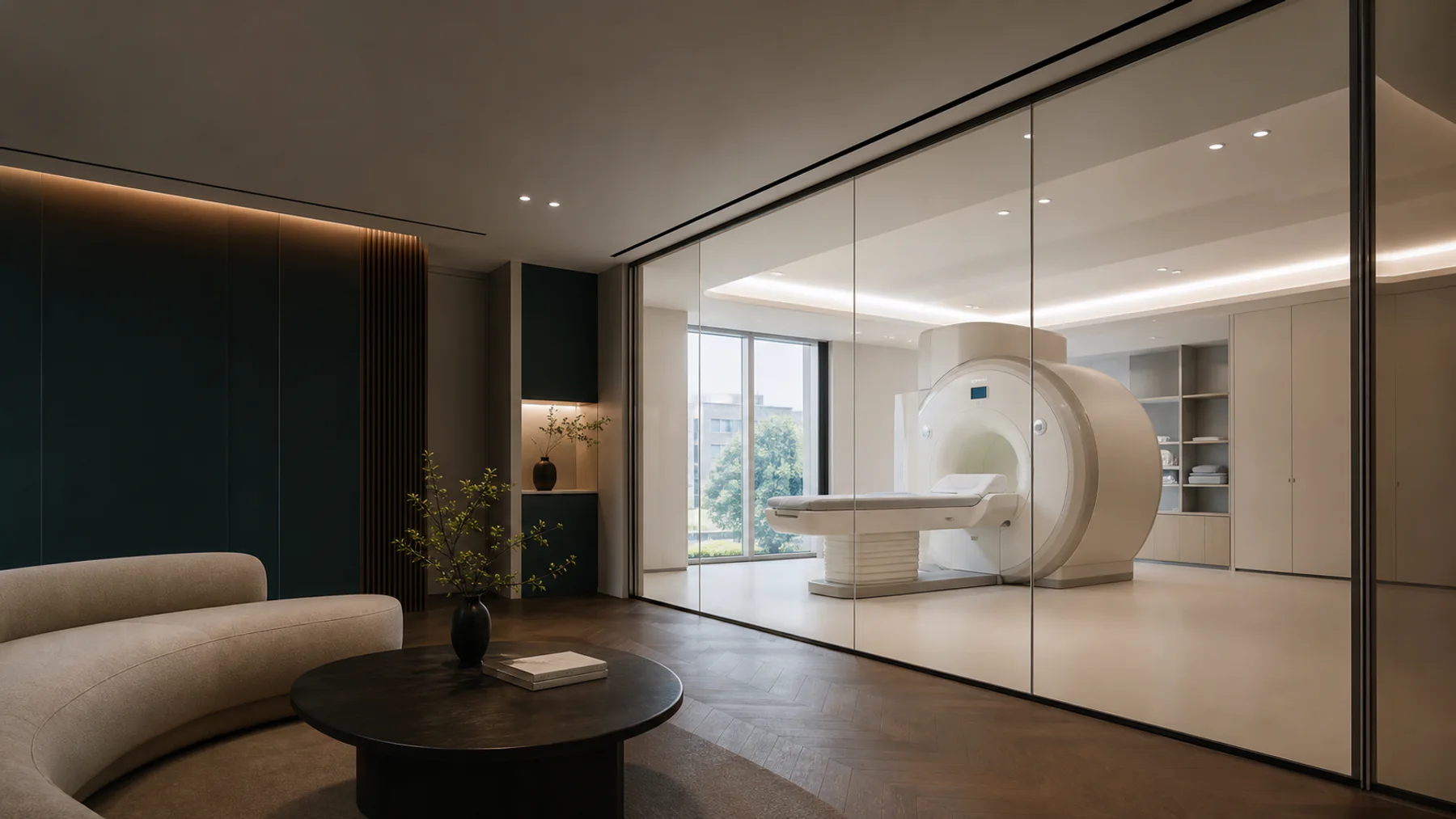
A comprehensive checkup in Korea is not one method, it is a hospital-grade programme that runs several in a single morning: CT and MRI, ultrasound, blood work, and endoscopy, from about $373 on the partner centres’ own published prices. The pricing page sets the tiers out, and a fuller guide walks through what each one covers.
The line that matters most in this comparison is endoscopy. A gastroscopy and a colonoscopy look at the lining of the stomach and colon directly, and can remove or sample a lesion in the same sitting. None of the Western products above does that. The gastroscopy is the same story for the stomach as the colonoscopy is for the colon, a direct look at a surface no scan images from the outside, which is one reason the stomach and colon are routine in an Asian programme and absent from a scan-only one. It is not a small omission, because the colon is one of the two things a whole-body MRI specifically cannot clear.
Reading the differences honestly
Three things separate these, and pretending otherwise helps no one.
On price, a Korean package sits at the low end. Its entry figure, near $373, comes in under Neko’s $499 New York price while carrying hospital-grade multimodal scope, and it is a fraction of a Prenuvo or Ezra whole-body MRI. Because none of this is reimbursed by insurance on either side, the comparison is self-pay against self-pay, which a separate article explains.
On depth, the split is real in both directions. Neko is not MRI, so on cross-sectional imaging a Korean programme is deeper. Prenuvo and Ezra are MRI, so on radiation-free structural imaging they are strong, but they carry no endoscopy, so on the stomach and colon a Korean programme reaches where they do not.
On access, a US service has the convenience of being close to home. A Seoul checkup asks for a flight and repays it in scope and price, and it fits most naturally into a trip to Asia you are taking anyway.
| Service | Method | Price | Endoscopy? |
|---|---|---|---|
| Neko Health | Surface sensors + blood + AI (no MRI) | $499 | No |
| Prenuvo | Whole-body MRI | $1,199–2,499 | No |
| Ezra | Whole-body MRI + blood | $999–3,999 | No |
| Korean checkup | Multimodal, CT + MRI + ultrasound + endoscopy + blood | from ≈ $373 | Yes |
Which one suits you
If you want the cheapest broad baseline within reach of home and do not need organ imaging, Neko answers that. If you want a radiation-free whole-body MRI without leaving your city, Prenuvo or Ezra answer that, with the colon and small lung nodules left for another test. If you want hospital-grade multimodal screening that includes endoscopy, at a package price below a single US whole-body MRI, and a flight is acceptable or you are visiting Asia regardless, a Korean checkup is the one built for that.
Whichever way it falls, read any result alongside your own physician. When you want a fixed price against your own dates, the request form returns one before you commit to anything.