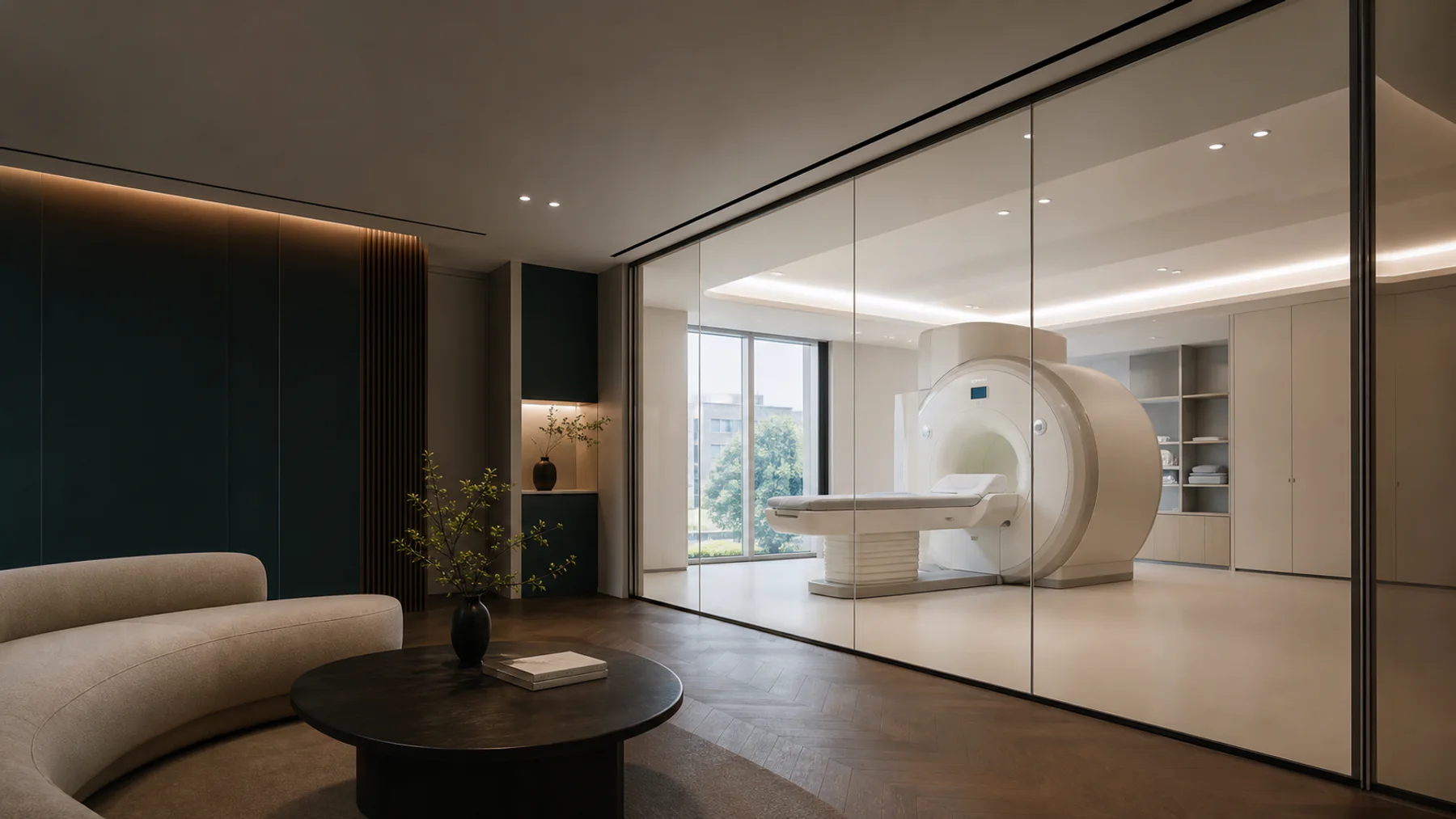
A comprehensive health checkup in Korea takes about a half-day, costs somewhere between $373 and $5,977 depending on the programme, and is genuinely bookable from abroad by someone who has never set foot in the country. That combination is why a growing number of international patients fly to Seoul for a screening they could, in principle, get at home. This is the practical version of how it works, what it covers, what it costs, and how a foreign patient actually arranges one.
Why people come to Korea for a health checkup
Three things make a Korean health checkup worth a flight rather than a wait at home. It is fast, the prices are published, and the whole exam fits in a morning.
Fast means days, not months. A self-pay screening slot in Seoul can usually be held about a week out, with no referral step in front of it, while the same MRI or colonoscopy on a public list abroad can sit behind a wait measured in months. The comparison pages on this site set that difference out market by market, each figure carrying its own source.
Published prices mean you can check the number before you fly. Korean law requires a screening centre to publish its non-covered (비급여) prices, the list for anything national health insurance does not pay for, and a self-pay checkup is exactly that. So the figures below come from the four partner centres’ own programme documents rather than from a middleman’s quote. That is a different kind of number from a facilitator’s markup, and the difference is worth understanding before you compare quotes. A separate article walks through why a price you find through a booking agency is often not the centre’s own.
A half-day means the medical part does not eat your trip. The scans, the endoscopy and the blood work for a full programme happen in one scheduled morning at one centre, which is what lets a screening sit at the front of a short visit rather than defining it.
What a comprehensive health checkup in Korea includes
The partner centres build their programmes as a ladder, and what changes between tiers is how far up the ladder you go, not the quality of any single test. Bloods, ultrasound and a gastroscopy sit at the entry level. A CT scan, a carotid ultrasound and a colonoscopy under sedation get added in the middle. An MRI gets added at the top.
| Tier | Price | What it covers |
|---|---|---|
| Essential | $373–633 | Bloods and tumour markers, chest X-ray, abdominal and thyroid ultrasound, ECG, bone density and a gastroscopy. |
| Comprehensive | $671–1,490 | Adds one CT scan, a carotid ultrasound, a cardiac ultrasound and a colonoscopy under sedation. |
| Advanced | $1,639–5,977 | Adds an MRI by region, brain, cervical or lumbar, and a women's programme adds a breast ultrasound. |
Every figure there is a range for two honest reasons. Four partner centres sit behind the tiers and do not price identically, and within a centre a women’s programme that adds a breast ultrasound costs a little more than the men’s. The full per-programme breakdown, centre by centre, is on the pricing page, and a longer article explains the arithmetic behind the ranges. The dollar figures are what is quoted and held; each centre’s own won price sits behind them at ₩1,342 = $1, read the same day.
How a foreign patient books one
The reason this works from abroad is that none of the booking depends on being in Korea. The flow is five steps, and the how-it-works page has the detail.
First, you send your history, any prior results and your travel window, and a coordinator replies within a business day with which programme fits. Second, your programme, a fixed price held in your own currency, and an exact test-day schedule are confirmed before you pay anything. Third, you fly in and the whole exam happens in one scheduled morning. Fourth, you get a same-day consultation on preliminary findings before you leave, and the full written report in English follows afterwards, usually two weeks later (one week at the soonest, three at the latest). Because that report lands after you are home, your visit is as long as the exam and no longer.
If you are travelling from the United States, there is a way to spend almost none of your trip on the screening at all, by lining the checkup’s fasting morning up with the fasting overnight of a long-haul flight. A separate guide sets out how.
Is it worth the flight
That depends on why you are screening and where you are coming from. If a scan you want sits behind a long wait at home, or the cash price there is several times higher for the same test, the arithmetic tends to favour the trip. If you have easy, cheap access to the same screening at home, it may not. What Korea reliably offers is speed, a price you can check before you commit, and a half-day exam that leaves the rest of the trip yours. What it does not change is the value of reading any result alongside your own doctor, which is why the report is built to be handed straight to a physician back home.
When you are ready to price a specific programme against your dates, the request form is where you name both and get a fixed figure back.