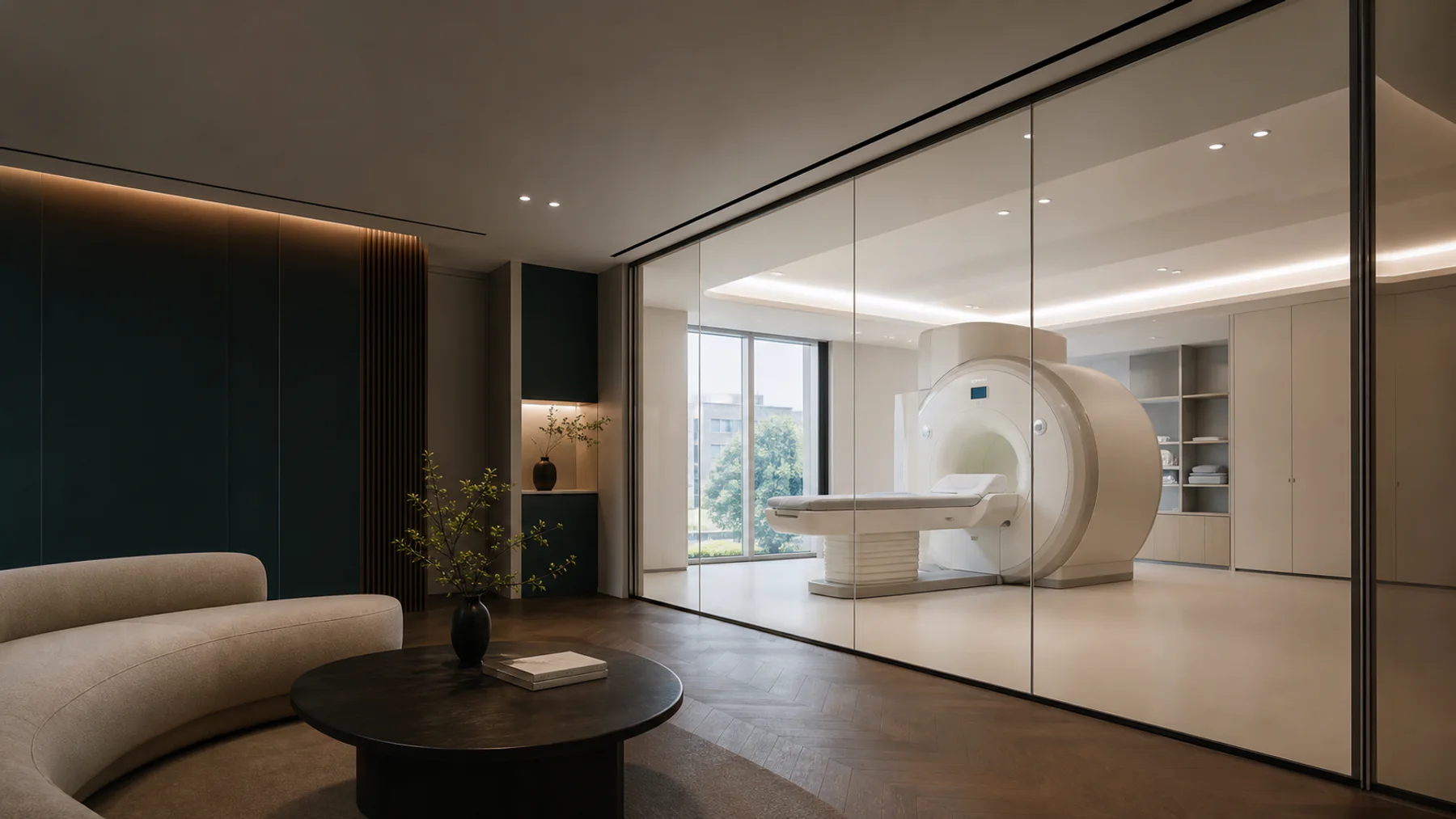
A full health checkup at one of the Korean screening centres behind this site costs somewhere between about $373 and $5,977, depending on how much the programme covers. The entry-level Essential tier runs $373–633. The mid Comprehensive tier (the one most people booking a full panel end up choosing) runs $671–1,490. The MRI-inclusive Advanced tier runs $1,639–5,977. Every one of those is a range rather than a single number, and that is on purpose. The reason follows below.
Why these figures can be checked at all
This is the part of the story that actually matters, more than any of the numbers above. Korean law requires a screening provider to publish its non-covered (비급여) prices, meaning the price list for anything national health insurance does not pay for. A self-pay comprehensive screening programme is exactly that. That legal requirement is the entire reason this article can name a figure at all. Four partner centres publish their own programme documents: KMI (한국의학연구소), Medione (메디원), Severance Health Check-up (세브란스 헬스체크업) and Hanaro Medical Foundation (하나로의료재단). Every figure below is read from our price ledger, which holds those four documents at version 2026-09-13.
That is a genuinely different kind of number from most of what circulates about paying for care abroad. A facilitator’s quote, a travel package price and a figure repeated in a forum post are not required to match a published source, and none of them can be checked against a page the person quoting you does not control. A legally mandated price list can be checked: you can go to the centre’s own site, read the same number, and note the date you read it, which is exactly what sits behind every figure on this page.
The three tiers
| Tier | USD | What it adds |
|---|---|---|
| Essential | $373–633 | Bloods and tumour markers, chest X-ray, abdominal and thyroid ultrasound, ECG, bone density and a gastroscopy or upper-GI series. |
| Comprehensive | $671–1,490 | Adds one CT scan, a carotid ultrasound, a cardiac ultrasound and a colonoscopy under sedation on top of the Essential tier. |
| Advanced (flagship) | $1,639–5,977 | Adds an MRI (brain, cervical or lumbar), a KUB scan and a colonoscopy under sedation on top of the Comprehensive tier; women's programs add a breast ultrasound. |
The one number in won
Those dollar figures are conversions, shown because a reader thinking in dollars needs something to compare against. The published figures are what the centres actually quote. Those are ₩500,000–₩8,021,000 across the three tiers, at ₩1,342 = $1 (open.er-api.com, 2026-09-13). The amount actually charged is quoted in your currency at booking, not computed from this rate.
The ladder is the same at every centre
Every centre builds its programmes the same way. Bloods, ultrasound and a gastroscopy sit at the entry tier. A CT scan, a carotid ultrasound and a colonoscopy under sedation get added for Comprehensive. An MRI, a KUB scan and a breast ultrasound for women get added again for Advanced. What differs between centres is not what gets tested. It is how much of that ladder a given tier includes, and what it costs to get there.
That shared structure is also why the figures above are ranges rather than single point prices, for two separate reasons. First, more than one centre sits behind each tier, and they do not price identically: bloods-through-gastroscopy might run $373 at one centre and $727 at another for what is functionally the same panel. Second, within a single centre, men’s and women’s prices are not always equal: a women’s Advanced programme that adds a breast ultrasound costs more than the men’s version at the same centre, on the same day, from the same published list. A single figure would hide both of those differences, which is why none appears here.
What the price does not tell you
A price list tells you what you will pay. It does not tell you when you will have an answer, and it does not tell you whether the number you were quoted is the one above at all.
On timing: a price list says nothing about how long the written report takes, and that is a separate question with its own answer. A separate article carries what each centre publishes about report turnaround, dated the same way these prices are. It is worth reading before you weigh a same-day promise against anything above.
On the quote itself: nothing here tells you whether a price you have already been shown by a booking agency or facilitator is the centre’s own published figure or a different number built on top of it. Those are not always the same, and the gap between them is not something a price list alone can reveal.
How to check this yourself
Nothing above is estimated or invented. It is what the four partner centres each publish, dated to the ledger version it was read into. That is the actual advantage of a system that legally requires disclosure: you do not have to take this article’s word for any of it. A separate article on this site walks through why a price found through a booking agency is often a different, marked-up number from a centre’s own published list, and what tends to explain the difference. It is worth reading before you compare a quote against anything above. The most reliable check, though, is still the simplest one: go to the centre’s own page, read the number for yourself, and note the date you read it. That is exactly what this article did.