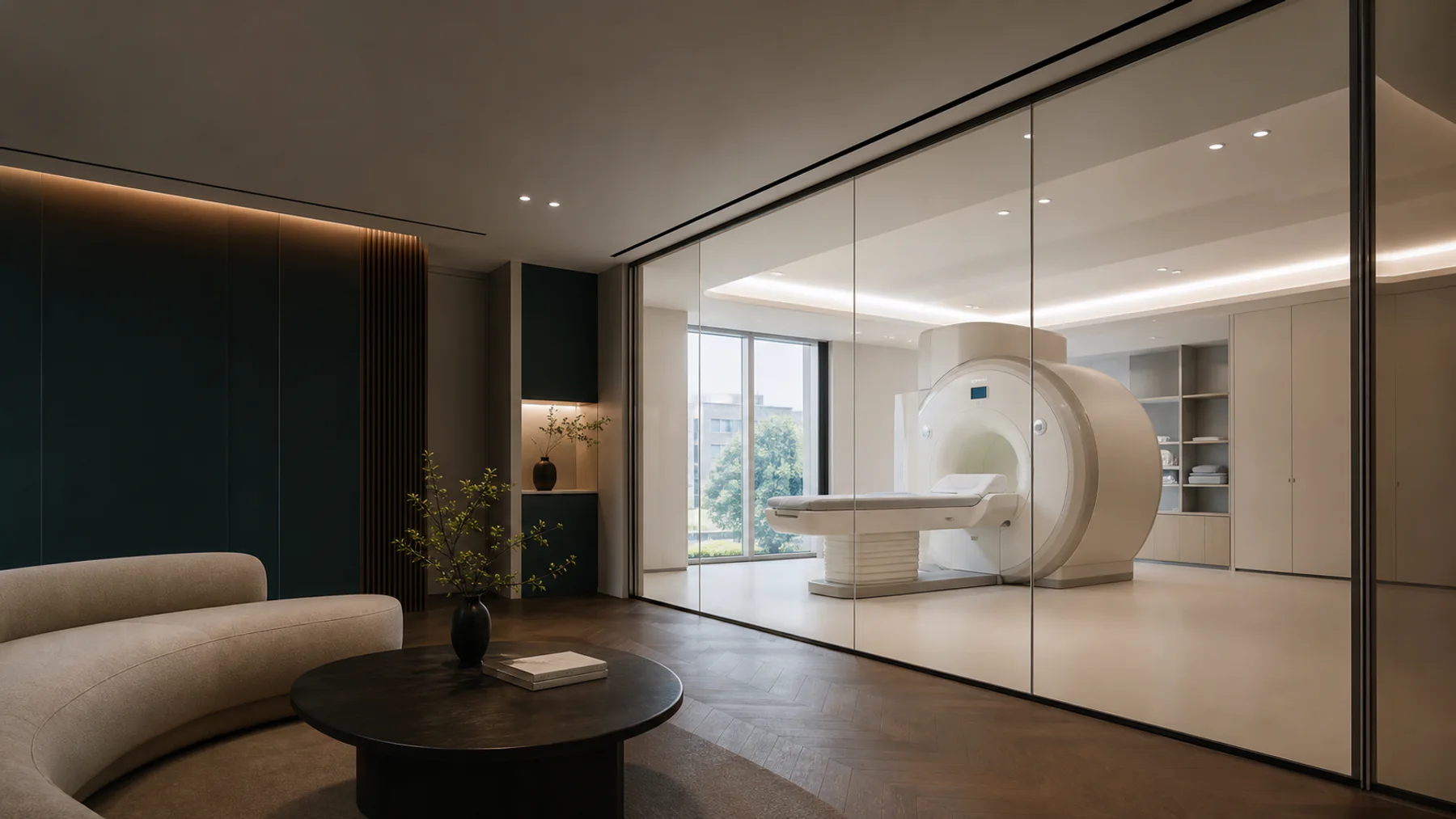
You do see a doctor on the day you are scanned in Korea, but the written report (the document you would actually hand to your own physician) takes two to three weeks to arrive, not the same day.
Both of those things are true at once, and that is exactly why “same-day results” is a confusing phrase rather than a false one. A same-day consultation is real: the tests that read immediately, mostly imaging and a first pass on bloodwork, get discussed with a doctor before you leave the building. A written report is also real, and it is not the same artefact. It is the consolidated document — every test, every finding, formatted and signed — that takes weeks to compile because some of what feeds into it, lab cultures, certain panels, a second radiologist read, simply is not ready that fast anywhere. “Same-day results” is a shorthand that quietly picks the first of those two things and lets a reader assume it covers the second. It doesn’t, and no single centre’s marketing needs to be blamed for that; it’s a natural collapse of two separate timelines into one word.
What the centres actually publish
Rather than take anyone’s summary of this, including this article’s, the honest move is to look at what each centre states on its own site about how long the full report takes.
| Centre | Published turnaround |
|---|---|
| KMI (한국의학연구소) | About two weeks or more from the exam date. |
| Hanaro Medical Foundation (하나로의료재단) | Publishes no turnaround figure at all. |
The Hanaro row is the actual point of this whole article. It would be easy to take KMI’s figure, round it into a tidy “about two weeks,” and present that as Korea’s answer. That number would be fabricated for Hanaro, because Hanaro does not publish one. Its site states only that results are delivered by email or on a mobile device, whichever you choose at registration. No elapsed-time commitment appears anywhere on the domain. That gap is not unique to report timing, either: a separate article on this site finds the same shape of silence in KMI’s own comprehensive package prices, published nowhere at all rather than merely higher or lower than expected. A provider choosing to publish nothing, twice now on this site, starts to look like a pattern of its own. The honest summary, and the one this article is built to state instead of a cleaner-sounding invented one, is that report turnaround is two to three weeks depending on the centre, and not every centre publishes a figure at all. No single number covers them all.
What is genuinely same-day
Set the written report aside and the same-day claim gets a lot more honest. A same-day consultation is a real feature of how these centres work, not a marketing invention. Imaging that a radiologist can read on the spot, and bloodwork that comes back from an in-house analyzer rather than an outside lab, are typically discussed with a physician before you leave the building on the day you were scanned. That conversation can flag something that needs immediate attention, and it can also just reassure you that nothing on the fast-turnaround tests looked wrong.
What it cannot do is stand in for the full report. Anything that has to travel to an external laboratory — certain specialised panels, a biopsy if one was taken, genetic testing where it’s part of the program — is not part of that same-day conversation, because the sample has not even finished being processed yet. Neither is the consolidated document itself: the single file that pulls every test result, every image finding, and every physician’s note into one signed report, which is the thing you would actually hand to your own doctor back home. That document is a compilation job, and it takes as long as its slowest input, which is why it lands weeks later rather than hours later.
Where this stops being an advantage
It’s worth being direct about something this site used to imply and no longer does: two to three weeks is not obviously faster than what you would get from a well-resourced health system elsewhere. Some markets publish a faster written-report turnaround than that, which is enough on its own to sink a head-to-head “our report arrives faster than theirs” claim. What this article will not do is put a number on the other side of that comparison: no home-market turnaround figure has been read off a named source and dated the way the Korean figures above were, and quoting one without that would be the exact move the rest of this piece argues against. The directional point stands without it. Report speed is not the reason to choose a Korean centre, and this site has already retired it as a selling point rather than keep repeating a margin that only holds against some markets.
What the actual advantage is
The part of this that does hold up, consistently, is not how long the report takes once you’re in the system. It’s how long it takes to get into the system in the first place. In Seoul, the gap between deciding to get a comprehensive screening and actually being scanned is measured in days. Booking, imaging, bloodwork, and the endoscopy or colonoscopy component, if your program includes one, typically happen within the same short visit, scheduled directly rather than queued behind a waitlist. That is a different kind of speed than report turnaround, and it is the one that survives scrutiny regardless of which country you’re comparing against: a system where you wait weeks or months just to get an appointment for the same panel of tests is starting from a slower point than Seoul, independent of how many days its own report then takes to compile afterward. This article is not going to attach a specific number of weeks to any particular home country’s waitlist. That figure isn’t sourced yet on this site, and stating one here would repeat the same mistake this piece is trying to avoid on the report-turnaround side. The comparison that holds is the structural one: days to be seen and scanned in Seoul, against a wait that in most systems is measured in weeks or months, whatever the exact figure turns out to be where you live.
What to ask before you book
Given all of that, the useful question to put to any centre before booking is not “how fast are results,” because that question conflates two different timelines the way the marketing phrase does. Ask three narrower things instead: when the full written report will actually arrive, what language it will be written in, and what format it comes in (a PDF you can forward, a physical binder, a portal login). Those three answers tell you whether the document you’ll eventually receive is one your own doctor back home can actually use. For what a usable report needs to contain and who has to sign it before it counts as something a physician elsewhere will accept, see /reports/.